The forgotten fortress of Arcadia
Just outside Andritsaina, on a hill overlooking the mountainous areas between Ilia and Arcadia, lie the ruins of a virtually unknown but fascinating monument: the Castle of Thisoa, also known as Castle of Saint Helena ή of Lavda.
Today the place seems quiet and almost mysterious. However, centuries ago there was an important fortress here that guarded the passes of the area and was part of the strategic defense of the Morea.
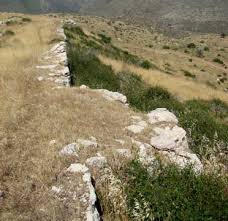
The most impressive fact is that the fortress was not built from scratch. The 13th century Franks built the castle on the walls of the ancient city of Thesea, using the existing fortifications. For this reason, even today, large sections of ancient Greek fortification can be seen with huge stones, built without mortar – a technique reminiscent of the great fortifications of ancient cities.
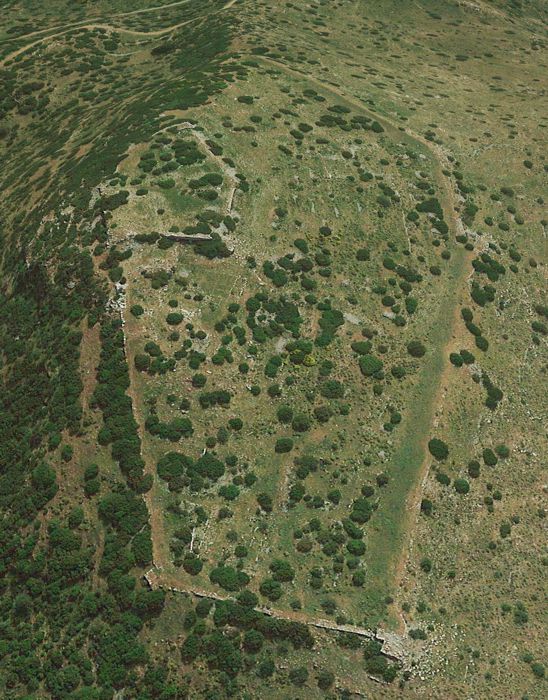
The fortification of the ancient city was impressive: it covered approximately 42 acres with a perimeter that reached 880 meters, while inside there was a smaller acropolis of about 3.5 acres.
One of the first castles of the Frankish period
The castle appears to have been built in the early 13th century, probably around 1210, in the early years of Frankish rule in the Morea.
At that time the capital of the Principality of Achaia was Andravida, and the Franks needed forts to control the passes to it. Thus a network of fortresses was created to protect the area.
The castle of Thisoa along with the Krebakore constituted two of these defense points, allowing control of the mountainous hinterland.
Inside the castle there was a church dedicated to Saint Helena, from which it probably took its medieval name.
The rebellion that led to the destruction of
The history of the castle is also connected to an episode of tension between the Franks and the local Greek population.
The 1304, the inhabitants of the region rebelled because of the heavy taxation imposed by the prince Philip of Savoy.
The rebels asked for help from the Byzantine governor of Mystras, who sent an army to the area. With this help, they managed to capture the castles of Mystras. Saint Helena and his Krebakore, which were almost completely destroyed.
After these events the castle probably never repaired again. That is why it does not appear in later lists of Frankish castles of the 14th and 15th centuries.
Thus the fortress was abandoned and slowly disappeared into the landscape.
The castle through the centuries
In the 19th century, European travelers began exploring the ruins.
The English traveler William Leake in 1830 he described the acropolis as a large circular enclosure with a diameter of about 130 meters, while later the French traveler Buchon recorded that the hill was then called Saint Irene, probably a corruption of Saint Helena.
Today, parts of the walls and traces of towers survive – at least seven, mainly square but also a circular one.
During the research, even fragments of columns have been found, possibly from ancient Doric temple, which indicates that the site may have had religious significance long before the castle was built.
Mythology of the region
The ancient city Thisoa is associated with mythological traditions of Arcadia.
According to tradition, the city took its name from the Thisoa, the king's daughter Lycaona, the mythical founder of many Arcadian cities. Lycaon is considered one of the first kings of Arcadia and his story is connected to the myth of transformation into a wolf, one of the most ancient Greek myths. The cities founded by Lycaon's children were many, and Thesea is considered one of them.
Thus, the hill where the ruins of the castle stand today carries a history that begins not only from the Frankish period and antiquity, but also from the oldest mythological narratives of Arcadia.
A monument worth discovering
The Castle of Thisoa is one of those places that you won't easily find in tourist guides.
However, it combines ancient history, medieval events and mythological roots, all on a hill overlooking the wild and authentic landscape of the mountainous Peloponnese.
If you find yourself in the Andritsaina area, it's worth exploring a little. The ruins may be silent today, but their stones still tell a story of centuries.